
Abington Township Busted Mugshots
Abington Township counted 58,502 residents in the 2020 Census, and its police work falls to the Abington Township Police Department. The department posts a weekly Police Blotter with an archive behind it. Officers are on duty around the clock. Administrative desks, though, keep their own separate weekday hours. Keep in mind that the blotter tracks local incidents; it is not a roster of people booked into the Montgomery County Correctional Facility.
County sources split by function, and each answers a different question. Police records document the local incident. Pennsylvania UJS Case Information surfaces eligible public court events. MCCF handles county custody, holding both people awaiting trial and those serving sentences. PA SAVIN runs a registered custody-notification service. None of this turns the blotter into a booking-photo gallery, and the county sources do not confirm any public live roster or current photo feed.
Where Abington Busted Records Appear
Begin with official municipal and county channels. The rows below separate a local incident source from a booking or custody claim, and they flag countywide third-party pages as nothing more than caveated leads.
| Channel | Photo status | Source status | What it can show |
|---|---|---|---|
| Abington Police Blotter | No booking photos documented | Official | Weekly, incomplete incident index |
| Abington archive | No photo roster | Official | Older municipal postings |
| MCCF facility information | No public roster verified | Official | County facility contact and custody routing |
| UJS Case Information | No photo function | Official court source | Eligible public case events |
| RecentlyBooked Montgomery | Site-displayed images when available | Unofficial | Possible historical or recent lead |
| Mugshots.com Montgomery | Archive images or markers | Unofficial | Historical county archive, not current custody |
RecentlyBooked advertises a rolling window of roughly the last thirty days, with several updates daily. Mugshots.com follows an older archive pattern instead. Both are commercial products of their operators. Neither amounts to a county certification, and neither can tell you whether someone sits at MCCF today, was convicted, or has a case still moving.
Find an Abington Busted Booking
Match the source to the question. A report of an Abington incident, a question about current custody, and a question about a court outcome each need their own channel. One generic search result cannot safely answer all three.
- Check the relevant weekly blotter period and its archive for the incident date, block, description, and agency context. A listed item may still be a call or investigation rather than an arrest.
- For a particular report, contact the Abington Records Room with the place, date, and type of case. The agency may limit access to eligible parties.
- Search UJS by the applicable participant name, case number, or police incident or complaint number if one is available. Public searches can omit sealed, expunged, juvenile, limited-access, or destroyed records.
- If reliable information says the person was detained after the initial proceeding, contact MCCF at 610-635-7100. Do not interpret the facility page as a person-level status result.
- Use the countywide record guide for state, federal, and notification channels that cover different custody populations.
County process material says an arrested adult goes before a magisterial district judge within 24 hours. From there, several things can happen. The person may be released, given a bail condition, held in county custody, or moved into the court process, all before a news item or third-party entry gets updated. So cite the date and the custody state a source actually supports. An old entry is not a current status.
Abington Police Records
For a routine Abington incident, start with the municipal department. Its FAQ guidance keeps requests simple. State where and when the event took place, plus what kind of report you want. Access may be limited to named parties. The listed police-report fee is $15 and nonrefundable. Confirm current fees and eligibility with Abington before sending payment.
Abington Township Police Department
Address: 1166 Old York Road, Abington, PA 19001
Phone: 267-536-1100
Department status: Always open
Administrative hours: Monday through Friday, 7:30 a.m. to 5:00 p.m.
Records route: Records Room
When the item sits in a county prosecution or law-enforcement file rather than Abington's municipal records, use the county DA Right-to-Know channel. The request must be written, specific, and non-anonymous. The office can withhold material under the criminal-investigative exception. Asking for an existing report or photograph never guarantees release. Nor will the agency build a new collection on request.
Abington's Blotter Is Not Busted Photos
The Abington Police Blotter runs in weekly date ranges and keeps an archive. That makes it far better for checking a dated local report than a stray social post. Its own disclaimer matters just as much. The blotter is a short, incomplete index pulled from the records-management system, not checked against final incident reports, and open to errors and omissions. Entries typically list the incident, date, time, block, streets, municipality, and a description.
Plenty of blotter entries describe calls that never became arrests. The format simply cannot establish a booking, current detention, a court result, or where an image came from. The official Abington weekly blotter shows what this local discovery product looks like. Read it with those limits in mind.
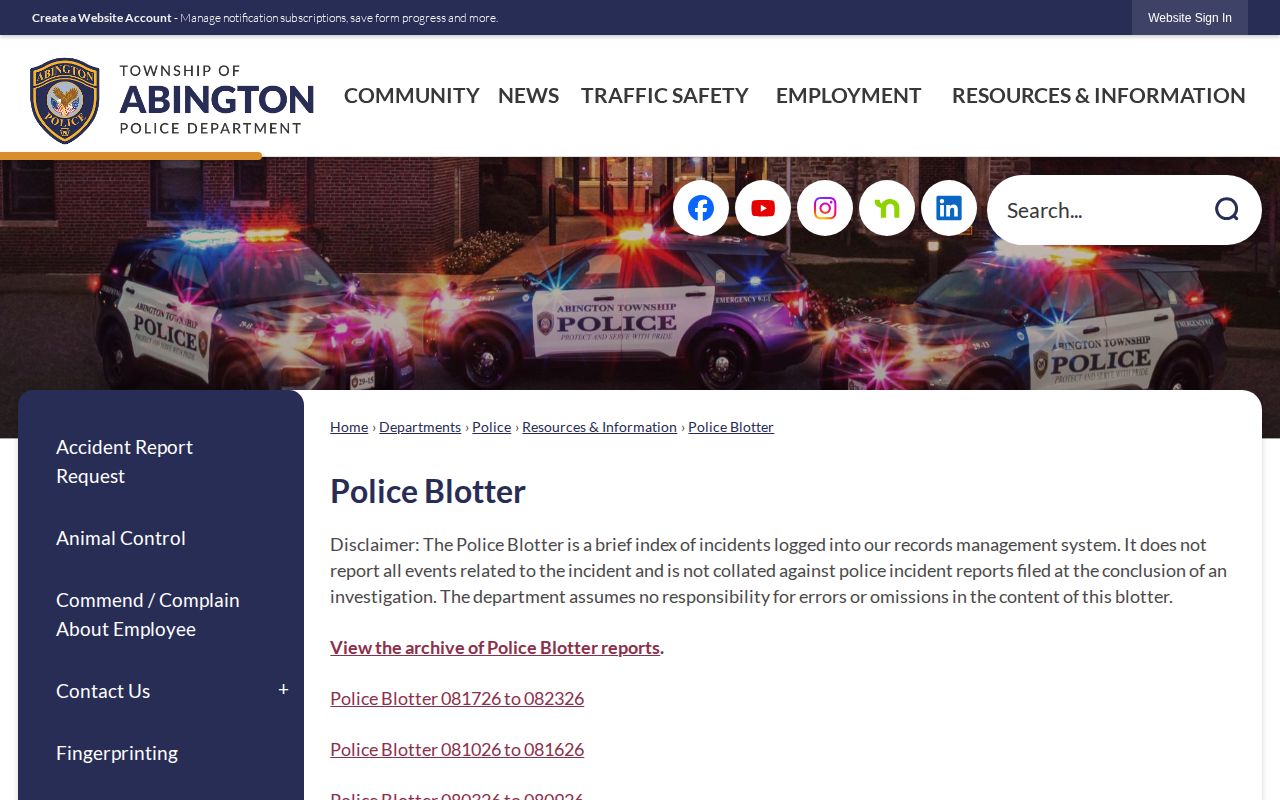
The weekly blotter page is a route, not a booking gallery. Read it as a first step toward a specific report request. Any later claim about a court outcome or custody should be verified on its own.
Abington Arrest Statistics Need Labels
The department's 2023 numbers give historical scale, not a picture of current bookings. The totals: 46,686 calls, 1,423 Part I offenses, 407 Part I arrests, 1,882 Part II offenses, 605 Part II charges, 3,706 traffic citations, 4,769 warnings, and 1,228 crashes. Every category counts something different. An offense total, an arrest count, a charge count, and a booking count are not interchangeable. Treating them that way distorts the picture fast.
These figures also cannot identify a person, establish who is detained today, or rank one neighborhood against another. What they do explain is why a broad incident product will always contain far more than arrest events. For an individual record, hold onto the agency, the date, the source type, and the exact wording. Never lean on a statistic as case evidence.
Abington Booking and MCCF Timing
Pretrial Services at MCCF runs every day, opening at 5:00 a.m. and closing at 11:00 p.m. Add the county's round-the-clock initial appearances, and an Abington arrest can move toward bail, release, or a court date fast. What the county does not offer is a public same-day feed tracking those changes.
A third-party listing can linger online after a person walks free, and a court docket may surface later or stay closed off entirely if the record is protected. Precision matters. Describe what you can actually support: a reported incident, a reported arrest, a court event, or custody at the jail only when a source confirms it. Vague labels create errors; careful ones prevent them.
Verify an Abington Busted Case
Say a local report names a person arrested in Abington. Head straight to the public court record. Skip the headline. Skip the aggregator page too. UJS searches run on participant name, case number, organization, offense tracking number, or a police incident or complaint number, depending on the docket type. Before tying a docket to a blotter entry, match the agency, the date, the municipality, the charge wording, and any identifier the listing supplies. A shared name proves nothing in a countywide court system.
Not everything appears in the portal. Juvenile, expunged, sealed, limited-access, and destroyed records can all stay out of public view. For county-level criminal records, the Clerk of Courts handles Common Pleas cases, while the Abington Records Room covers the municipal incident route. Send each request to the office that actually administers it.
What an Abington Record Does Not Show
Every Abington source answers one narrow question. None fills in for the rest. A police blotter identifies a publicly listed incident. A docket shows an eligible case event. MCCF routes facility contact but offers no public name search, and PA SAVIN pushes release, transfer, or escape alerts to registered users. Treat each as its own tool, not interchangeable proof.
This matters most when a record has gone stale or thin. Suppose a news story says someone was remanded to MCCF. Keep the publication date attached. Frame it as a historical statement about that moment. If a court result later says otherwise, the court record wins on the outcome. When an unofficial listing shows a different date or agency, resist merging it just because the municipality matches.
Abington Archives and Older Reports
Abington's archived weekly-blotter material can help you find an older municipal post. It is not a permanent booking repository. The county publishes no MCCF booking-photo retention schedule, and no official municipal page promises that reports or images stay online for any fixed period. Corrections, records-access rules, site redesigns, sealing, and expungement all shift what remains available over time.
For older county matters, try the Montgomery County Archives at 86 Eagleville Road. Staff there can pinpoint an indexed item and its legal custodian. The Archives cannot replace a police report, an MCCF inquiry, or a court record. Bring the approximate date, the agency, the facility if known, and the exact record type you want. Then let the responsible office explain what, if anything, can be released.
Abington Arrest Coverage
For coverage that moves faster than the weekly blotter, local newsrooms fill the gap. County DA press releases, 6abc's Montgomery County index, Patch, and MONTCO.Today all report on Abington arrest events as they happen. When you read these stories, keep the details attached to their source. Note which agency is credited, when the piece ran, and any court date the reporter included. Photos deserve the same care, since a story's image might come from an agency, be purely illustrative, or be pulled from somewhere else entirely. The caption tells you which.
Treat any unofficial county listing as a starting point, nothing more. From there, confirm details with the arresting agency or public court records. A fuller set of dated local coverage lives in Montgomery County crime news.